Here I go again, writing on a topic of which I know very little. BUT, I know enough to have made the decision, for now, not to keep horses at home. There are a number of things I had not considered early on in our horse journey which came to light as I explored the possibility of moving to a horse property and keeping horses at home. For me, these details gave me pause, but for others they may be no big deal.
There are many reasons for keeping horses at home - reduced costs, more time with them, control over their care. The whole thing looks very different if money is no object than it does if you are on a tight budget. For our purposes, I'm going to be practical and assume you are not the type with bottomless pockets.
If you have more than one horse, you can't help thinking about the financial savings of keeping horses in your backyard rather than boarding them. Here in the Metro-West area outside Boston, board is extremely expensive ranging from $1,000 - $1,300 a month within a reasonable distance of our house. It's similar to the economics of day care vs. a nanny. The more kids you have, the more cost effective the nanny option looks.
The first thing we thought about when exploring the option of keeping the horses at home was the monthly cost of doing so. If you do all of your own barn chores, the cost to feed a horse in this area is about $350 per month which includes hay and grain. If you will have nice grass turnout that cost may go down a bit in the summer since they can graze and reduce your hay costs. Hay is about $10 a bale and a horse eats about a bale a day, maybe 3/4 of a bale. Your other significant cost is bedding. You will need shavings or some other form of bedding for your stall. If you have a run in stall, your bedding might last longer than if your horses are kept in all night. Regardless, plan for about $100 - $150 a month for bedding. I'm not including supplements in this discussion since their cost is the same whether the horses are at home or boarded somewhere else.
It looks like keeping horses at home could save us about $700 a month per horse (if you are doing everything yourself) which is pretty significant. But there are a few more costs to consider. First of all, there is the cost of living on a horse property. For us, moving to a town that allows horses would increase my husband's commute significantly and would have taken my two non-horsey sons away from a public school system they love so right there we had a deal breaker. But even if those pieces had fallen into place, we had a hard time finding a property we could handle that would give us everything we wanted. We currently enjoy the use of an indoor arena, several outdoor sand rings, jumps and fields. If we were at home, we would have reduced facilities.
Insurance and manure management are two additional significant costs. I am told by my friends who have horses at home that managing two is really not bad but adding a third horse seems to be a breaking point as far as the amount of mucking required and the quantity of manure you need to dispose of on a weekly basis.
Some rural towns will give you a good break on your property taxes if you are using your property as a working farm so look into the rules. The savings here might compensate for some of the costs listed above.
So now you've crunched the numbers, it's time to talk about the more subjective pros and cons of keeping horses at home versus boarding them. On the con side, having horses at home ties you down. My friends with horses at home are frequently looking for people they can hire to come take care of things when they want to go away for a weekend and it costs quite a bit to hire such a person. I believe they pay people about $100 a day for someone to come muck, feed and often stay overnight. Even when you are in town, horses tie you down. 7 days a week someone needs to be up early to feed them and turn them out. If everyone in the household is willing to take turns getting up and doing morning chores, then it might not be so bad. Horses need hay throughout the day unless they are turned out on grass so someone needs to be around to throw hay and fill water buckets in the middle of the day, everyday. And someone has to do night check, break the ice in the water buckets through the winter, change blankets, take care of emergencies, etc. There are some great devices such as automatic waterers and heated water buckets that will reduce your efforts but at the end of the day, horses need a great deal of care.
Horses don't usually like to be alone. If you have one horse you probably will want to provide the horse with a companion. You can run into trouble if you want to take one of the horses to a horse show or clinic for the day. Some of my friends end up dragging horse #2 along frequently so he doesn't get into mischief being home alone. You need to think through your program and consider what is the best number of horses to have at home for your lifestyle.
On the pro side, having your horses at home can be a great joy. I would love to have ponies in my backyard, to walk out the door and be with them any hour of the day. I would love to be at home more. My dog would prefer to have us home more! I could cook dinner while my daughter rode her horse. I think this becomes a bigger pro as the kids get older, have more homework and trips to the barn take up too much time. We could afford to have two horses if we kept them at home. That's probably the biggest argument in favor of the idea for me. And I assume the bond is much greater when you take care of your own horse each day.
Having a farm is a serious lifestyle choice. If you really want one, then go for it! If you are just trying to find a way to cut costs, make sure you are truly ready for the commitment. If you aren't super knowledgeable, do you have someone you can call if something goes wrong in the night?
And if you're thinking about taking on something bigger, a boarding facility, think again unless you really know what you are doing. I know it sounds completely logical to buy a ten stall barn, rent 8 out to cover your costs and bring in a little bit of money, allowing you to justify having horses. Running a boarding facility is a ton of work and, unless you plan to do every bit of that work yourself, you are unlikely to see a profit. Look into how much you can charge for board. Backyard barns can't charge the same type of board a facility with an indoor and large outdoor rings can charge. Trainers running their own facilities always say they break even or lose money on the board and make it up with teaching or running shows or hay sales or some other horse adjacent business.
The other issue with running a boarding facility is that your home is no longer your own private space. You will have people there all the time and often those people will feel entitled to tell you what to do and to ask you to change your home to please them. I think I'd have a difficult time with this aspect of taking in boarders.
If I haven't talked you out of it yet, then good luck! I'm jealous! And I really hope to follow in your footsteps some day.
Showing posts with label barn. Show all posts
Showing posts with label barn. Show all posts
Tuesday, May 31, 2016

Monday, March 30, 2015
Equine Laundry: Tips on how to deal with all that hair and dirt!
In a dream world, we would all have dedicated laundry machines for our horses, preferably in a separate room with a separate entrance. Since diving in deep with horses I've begun using our garage as a pre-mudroom. Particularly muddy boots are left in the garage. I wish we had a horse mudroom during shedding season when our coats are covered in horse hair. I hate dragging all that hair and dirt into my nice, clean house.
Here in the real world, my laundry machines are on the second floor with the bedrooms which seemed like a great idea at the time. Since the horses have to share with the humans, I've come up with a few procedures which make doing the horse laundry a bit less messy and hopefully prevent horse hair from ending up all over the clothing of the non-horse lovers in the house.
At home we wash saddle pads, fleece blankets, Baker blankets, Irish knits and non-water proof sheets. I have washed AND dried waterproof sheets in the past before I knew anything and honestly it did them no harm and they were still waterproof but I wouldn't count on that working out for an extended period.
Step one is to be sure all human laundry is totally done and that you won't need clean machines again for at least 24 hours. All human laundry is put away and the laundry room has nothing on the floor. I then dump all the horse laundry on the tile floor.
I have a good sized machine so unless we brought sheets home, our things fit in one load. We usually just have saddle pads. If you need to wash girths, they can go in the same load with the saddle pads. Just use some duct tape to pad the buckles. I like to tape the two buckles on each end together and wrap several layers of tape around them. This reduces the noise as they wash and dry and also protects your machines from scratching. If you have bulky metal pieces on any of your sheets or blankets I would suggest using duct tape for those as well. You can also remove leg straps and soak those in a bucket or laundry sink if you don't want to put them through the laundry. Dryers are particularly bad for elastic so you might not want to dry them in the machine even if you machine washed them.
Check the care instructions for your items. If you are washing things that cannot go in the dryer, have a plan for where those are going to hang. The reality is that the dryer is the workhorse in removing the hair from your horse laundry. We have an alternative solution but first you need to hang the items to dry somewhere that you either won't mind having lots of horse hair (clothesline?) or in a place that is easily cleaned up with a vacuum cleaner (basement?). I put fuzzy girths and basic saddle pads in the dryer. I do not put the Back on Track saddle pads in the dryer. I put all blankets, fleeces, Irish knits, etc. in the dryer. I have a friend with saddle pads that need to be hand washed so think about all of this when deciding what tack to use for your horse.
My system is based on front loading machines so I'm not sure if it will work as well with a top loader but give it a try.
After taking the laundry out of the washing machine and putting it in the dryer or hanging it to dry, I leave the washing machine open to dry over night. The next day I take the horse laundry out of the dryer and put it downstairs to go to the barn. I then use the hose on my vacuum cleaner to thoroughly clean the washing machine, dryer, lint collector, floor of the laundry room and tops of my machines. That horse hair gets EVERYWHERE!!!!
Then I turn to my line dried items. I vacuum the saddle pads. You can do this prior to washing but I actually find it works better for me to do it after. I run the vacuum back and forth over the saddle pad probably 20 or 30 times until the bulk of the hair is gone. For sheets and blankets I tend to just shake them out outside. I suppose you could try vacuuming but I think they need more heft so the vacuum won't just suck them up.
On occasion I have washed and dried blankets a second time through clean machines and used a dryer sheet to try and remove more hair. Of course I then had to clean the machines a second time.
For a Mattes pad or other sheepskin pad follow the manufacturer directions very carefully. Mattes pads come with special soap. They can be washed in a regular washing machine but in my experience they take forever to dry.
For medium and heave sheets and our water proof sheet if I don't feel like hanging it to dry after washing, I send them out to be cleaned. Dover Saddlery provides blanket cleaning and most barns have someone collect all the blankets for cleaning at the end of the winter. Expect it to take 4 - 8 weeks to get the blankets back from cleaning. In a pinch, you really need to just do it yourself. You can probably do a medium in your home machine and hang it to dry but a heavy would need a really good sized machine.
The other thought I have had is to take everything to a laundromat. It's kind of obnoxious to go infest public machines with all your horse hair but you've got to do what you've go to do!
It was during our first spring shedding season that Elizabeth and I became big fans of clipping our horse. When you clip in the winter it means you need to blanket your horse more heavily through the cold weather and of course if you clip on your own you make a huge mess. I usually wear a coat that is then sent immediately to the dry cleaner. I know other people who get full body plastic suits from Home Depot to wear while clipping. But the upside is that you don't have two months of horrendous shedding in the spring. We leave a decent amount of hair on our horse so even though she's trace clipped, she is shedding. But much less so than if we hadn't clipped her at all.
As for your winter coat (I have a brown one I call my medium and a black one I call my heavy, both fully dedicated to the barn and too filthy and smelly to go anywhere else) it's off to the dry cleaner. I've accumulated barn and non-barn versions of most outerwear at this point and footwear for that matter. I wait until May and off the coats go to be freshened up for the next winter which is never far enough away.
Here in the real world, my laundry machines are on the second floor with the bedrooms which seemed like a great idea at the time. Since the horses have to share with the humans, I've come up with a few procedures which make doing the horse laundry a bit less messy and hopefully prevent horse hair from ending up all over the clothing of the non-horse lovers in the house.
At home we wash saddle pads, fleece blankets, Baker blankets, Irish knits and non-water proof sheets. I have washed AND dried waterproof sheets in the past before I knew anything and honestly it did them no harm and they were still waterproof but I wouldn't count on that working out for an extended period.
Step one is to be sure all human laundry is totally done and that you won't need clean machines again for at least 24 hours. All human laundry is put away and the laundry room has nothing on the floor. I then dump all the horse laundry on the tile floor.
I have a good sized machine so unless we brought sheets home, our things fit in one load. We usually just have saddle pads. If you need to wash girths, they can go in the same load with the saddle pads. Just use some duct tape to pad the buckles. I like to tape the two buckles on each end together and wrap several layers of tape around them. This reduces the noise as they wash and dry and also protects your machines from scratching. If you have bulky metal pieces on any of your sheets or blankets I would suggest using duct tape for those as well. You can also remove leg straps and soak those in a bucket or laundry sink if you don't want to put them through the laundry. Dryers are particularly bad for elastic so you might not want to dry them in the machine even if you machine washed them.
Check the care instructions for your items. If you are washing things that cannot go in the dryer, have a plan for where those are going to hang. The reality is that the dryer is the workhorse in removing the hair from your horse laundry. We have an alternative solution but first you need to hang the items to dry somewhere that you either won't mind having lots of horse hair (clothesline?) or in a place that is easily cleaned up with a vacuum cleaner (basement?). I put fuzzy girths and basic saddle pads in the dryer. I do not put the Back on Track saddle pads in the dryer. I put all blankets, fleeces, Irish knits, etc. in the dryer. I have a friend with saddle pads that need to be hand washed so think about all of this when deciding what tack to use for your horse.
My system is based on front loading machines so I'm not sure if it will work as well with a top loader but give it a try.
After taking the laundry out of the washing machine and putting it in the dryer or hanging it to dry, I leave the washing machine open to dry over night. The next day I take the horse laundry out of the dryer and put it downstairs to go to the barn. I then use the hose on my vacuum cleaner to thoroughly clean the washing machine, dryer, lint collector, floor of the laundry room and tops of my machines. That horse hair gets EVERYWHERE!!!!
Then I turn to my line dried items. I vacuum the saddle pads. You can do this prior to washing but I actually find it works better for me to do it after. I run the vacuum back and forth over the saddle pad probably 20 or 30 times until the bulk of the hair is gone. For sheets and blankets I tend to just shake them out outside. I suppose you could try vacuuming but I think they need more heft so the vacuum won't just suck them up.
On occasion I have washed and dried blankets a second time through clean machines and used a dryer sheet to try and remove more hair. Of course I then had to clean the machines a second time.
For a Mattes pad or other sheepskin pad follow the manufacturer directions very carefully. Mattes pads come with special soap. They can be washed in a regular washing machine but in my experience they take forever to dry.
For medium and heave sheets and our water proof sheet if I don't feel like hanging it to dry after washing, I send them out to be cleaned. Dover Saddlery provides blanket cleaning and most barns have someone collect all the blankets for cleaning at the end of the winter. Expect it to take 4 - 8 weeks to get the blankets back from cleaning. In a pinch, you really need to just do it yourself. You can probably do a medium in your home machine and hang it to dry but a heavy would need a really good sized machine.
The other thought I have had is to take everything to a laundromat. It's kind of obnoxious to go infest public machines with all your horse hair but you've got to do what you've go to do!
It was during our first spring shedding season that Elizabeth and I became big fans of clipping our horse. When you clip in the winter it means you need to blanket your horse more heavily through the cold weather and of course if you clip on your own you make a huge mess. I usually wear a coat that is then sent immediately to the dry cleaner. I know other people who get full body plastic suits from Home Depot to wear while clipping. But the upside is that you don't have two months of horrendous shedding in the spring. We leave a decent amount of hair on our horse so even though she's trace clipped, she is shedding. But much less so than if we hadn't clipped her at all.
As for your winter coat (I have a brown one I call my medium and a black one I call my heavy, both fully dedicated to the barn and too filthy and smelly to go anywhere else) it's off to the dry cleaner. I've accumulated barn and non-barn versions of most outerwear at this point and footwear for that matter. I wait until May and off the coats go to be freshened up for the next winter which is never far enough away.
Wednesday, February 5, 2014
I hate to sound silly, but what does my pony eat?

The most important component to a horse's diet is forage or roughage - grass or hay. Some horses in some climates live outside in grassy pastures all the time and graze. That is often their only form of sustenance. Lucky horses!
Because we have developed an artificial lifestyle for our horse athletes, we usually need to supplement their forage with concentrates - usually grain.
Succulents are the fun, "healthy" treats we like to give horses such as apples, carrots and fresh grass. They are a treat and should be given to reward good behavior and not given in excess.
And lastly, just like humans, our modern, artificially kept horses often take supplements - think of them as vitamins. Technically, supplements fall under concentrates but I order them separately and for beginners like us, they are easier to comprehend on their own.
So those are the basics. Now for the nitty gritty.
Horses have enormously long intestines and food takes about 3 days to make it's way through their bodies. It is important that they eat very little, very frequently. Horses need more food than ponies. Concentrates can be high in sugar and make ponies very excited - just like a child gets hyped up on cupcakes and ice cream at a birthday party.
According to my pony club daughter, roughage feed includes hay (varieties include timothy, clover, bermuda, alfalfa), grass, hay pellets, range cubes and sugar beet pulp. Hay pellets, range cubes and sugar beet pulp must be soaked before feeding. They expand in water so if you feed them dry, they will expand in the horse's stomach and can cause their stomach to explode. Which leads me to inform you of the fact that horses cannot vomit. Therefore, what goes in stays in unless removed surgically.
Horses eat hay all day and all night. They need this to keep their digestion moving. How much they eat depends on size. Hay is given at our barn first thing in the morning (6am?), they are then turned out with hay after their grain (if they get grain), given hay again around noon, 2:00, 5:00 and 9:00pm.
Horses have very sensitive systems. When there is a change in hay, they can react badly. Therefore, when any change is made, it should be made slowly. When we go away for a couple of days we travel with our own hay. If we are away for a week we may bring 2 bales and mix it with the new hay for a few days before changing over completely. Then we have to do the same thing in reverse upon our return home.
Concentrates are the means we use to control our horses weight and nutrition. Depending on your hay, your horse may not be getting all the nutrients he needs. There are a million different products out there to combat this problem. Many brands have comparable grain products and most barn managers know a reasonable amount about the grains they feed. Grain is usually fed twice a day, morning and late afternoon at our barn. Our pony didn't get any grain or supplements prior to living with us but we now feed him a tiny amount of MVP in the morning. MVP is a pellet form vitamin. It gives him some nutrition and something fun to eat in the morning. It also gives us something to mix with his supplements which come in powder form. We give him supplements for his digestion because he's kind of gassy. There are so many products and it is all incredibly confusing. Find someone who really knows what they are doing to help you figure out what your pony needs. He likely doesn't need anything!
On the topic of supplements, for people like us who have one pony and embrace convenience,
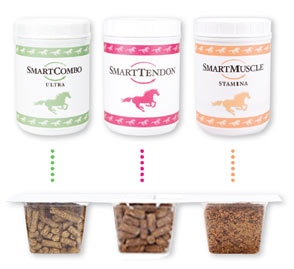 SmartPaks are a great thing. You can choose whatever supplements you feel your horse needs, determine the quantity (they are very helpful with this, professional vitamin salespeople) and whether you want them in the am or pm feed. The company then packages the supplements and ships them, usually free of charge, to your barn so whoever is doing the feeding at your barn just opens a pack each morning or evening and adds it in. If you instead choose to buy supplements in bulk you can make up your own packs using ziploc baggies. This is what we did with our first two ponies. It takes quite a bit of time and was tedious. SmarPaks are just easier for us. That said, not every supplement is available. Again, this is whatever works for you and your horse!
Another extremely important component of your equine diet is salt and water. Your horse should always have a salt lick in his stall. Take note of whether or not your horse is consuming the salt. And horses always need an ample supply of fresh water. This is something your barn should be providing throughout the day, especially in winter when the water buckets freeze over and need to be broken open with a hammer every few hours.
I'm sure you've heard the terms colic and founder but may not really know what they mean. Colic refers to a twisting of the intestines. With so much intestine floating around in their big horse bodies, horses are prone to this issue. How you feed them can contribute to or reduce the risk of colic. Horses should not eat concentrates just prior to or just after hard work. A little hay is OK but if you plan to ride around grain feeding time, ask the barn to hold the grain until after you ride. You should not ride for at least 30 minutes after grain is fed and should not give it to your horse after work until they are fully cooled down and have first consumed a little hay to get their digestive system going again. If the weather is good and you have time to graze your horse after riding, make sure that he is fully cooled down first. And be careful about how much grass you let him eat. Especially in the spring time the sugar content of the grass can be very high and too much sugar can cause him to founder.

What is founder? It is a condition of the hoof in which the coffin bone pulls away from the hoof. I don't fully understand it but this is a pretty good article if you would like to learn more. The thing you need to know is that too much sugar can seriously damage a horse's delicate system. It seems strange that sugar can cause huge issues in the hooves but that is exactly what happens. Horses' hooves are complicated and connected to their nervous systems. Unfortunately, once a horse has these hoof issues caused by founder, or laminitis, a different but equally horrifying hoof issue, there is little that can be done for them.
We have cared for three ponies. All three had significantly different diets and all three stayed nutritionally healthy. All three taught me something about feed. Our second pony had to have her hay soaked to remove dust - she had allergies. She also had monthly allergy shots. And she loved to eat. She is a prime example of ponies who just love to eat eat eat and it is up to us to help control that tendency. Our first pony on the other hand tended to be rather slim, unusual for a pony. Our current pony is super easy. I think he's pretty psyched to have morning grain. We don't give him afternoon grain and unlike the horses who know it's feeding time and start making noise around 3:00pm, he is happy to eat a little hay and do some work in exchange for a yummy treat. We've given different supplements to each pony as well. I'm not sure if any of them do anything but it makes me feel like a good caregiver. There are supplements out there for marsh behavior, for old age, to make their coat shiny and for anything else you can think of. They can be very expensive and some probably are worth giving.
As with everything, make sure you have someone who can help you with knowing what to feed your pony and when. That's the most important thing. If you can, spend a day helping out with feeding at your barn and learn from the people who work there. With 40 some horses at our barn it's fascinating to see all the different feed. Some people bring in their own hay because they like feeding alfalfa or timothy. Some horses have serious issues and need really special feed regiments. Some guys like ours just eat what they're given and seem to thrive on anything. Once again, horses are a lot like people.
If you care to read further on the topic, the pony club manuals have great information. The D Level Manual is a little shorter and more simplistic and starts on page 199. The C Level Manual is longer and goes into great detail starting on page 167. I highly recommend reading these books if you can find the time.
Happy eating!
Kristie
Friday, December 27, 2013
When is it time to change barns?
One of the hardest things we go through as beginner
horse moms is understanding if and when to change something - barns, trainers,
ponies, sports (there are many sports within the equine genre), vets, farriers.
There were two pieces of advice more experienced horse people shared
with me a year ago when my daughter wasn't as happy as a girl with her first
pony should be and I wondered if it was time to change barns. The first is that if you are thinking about
it, and thinking about it seriously enough to call strangers for advice, then
it is time to make the change. The
second is that once you’ve decided to make a move, the sooner the better. They were absolutely right and I’m surprised
I couldn’t see it then.
In life, it is usually best to look forward, not back. The time we spent in limbo was awkward. Even if no one else knows you plan to move,
you will feel strange every day until you do it! Change is hard. We don’t want to hurt people we’ve grown
close to. In some cases you may be
afraid of the trainer you are leaving or concerned about backlash down the
road. Thank God those were not on my
list of issues. But whatever your
situation, if it isn’t working for you, find one that will. We spend a crazy amount of time and money on
this sport and we have to feel good about the services we receive.
BUT before you jump the gun and decide your feelings
of frustration require a drastic change of barn, trainer, pony, whatever, talk
to your people. I don’t know why we are
shy about speaking up and voicing our concerns!
When my daughter looked as though she wasn’t thriving, I sat down with
the two instructors at our barn and talked about how Elizabeth was feeling.
They were awesome and jumped right in to help us make some changes.
I have other friends who feared the conversation only to find their
trainer could totally solve the problem and go with them to the more
competitive barn they were interested in.
Remember, it never hurts to ask.
Looking back I realize something pretty obvious. Though we are
grateful to the people who teach our children to ride and we often feel some
strong sense of loyalty, there will be few who stay in one place from the day
they ride their first pony until the time they leave for college. The
instructors all know this. Some are more sensitive about it, some more
mature and understanding. Some barns
really specialize in teaching little kids to ride and I often wish these barns
would embrace that role and initiate the conversation about a rider’s goals and
future, helping the parents choose a path to the next step even if it takes them to another barn.
So, if you have decided to make the change, how do you go about it? That’s probably a whole other post but here
are a few suggestions.
- If you know ANYONE, no matter how distant the relation or friendship, who has had a child go through the sport you are interested in, call them up and ask questions. I cannot stress enough how wonderful and willing to share most parents of horse kids are. Of course there are exceptions but I’ve always shared what I know and I got most of it from other moms! My first call was to the sister-in-law of an acquaintance. She had raised two hunter daughters and gave us a long list of hunter barns and IEA teams. Just before we hung up I mentioned my daughter’s interest in eventing and she thought there was an eventing barn very close by and gave us the name. I will be forever grateful to her.
- Go to your local tack shop and ask the manager about local barns. They may have a list. Also ask about what magazines cover equestrian sports in your area. Now that I read Equine Journal and Massachusetts Horse regularly I’m wondering where these wonderful publications were during my time of need. They have listings for barns by discipline, including our beloved barn!
- Contact the DC (District Commissioner) of your local pony club. There is a national pony club website that lets you search for clubs by zip code. Whether you have any interest in joining pony club or not (though I strongly encourage you to do so if you can fit it in and will go into great detail as to why in another post), these people are extremely well connected in the horse world within your geographical area. If they can’t tell you what you need to know they will know someone who can. And on average, pony club people are very generous with their knowledge.
- If all else fails, google for barns in your area and start dialing! This was probably the least productive of all the things I did but it was kind of fun and I learned a few things including the fact that the biggest and most stunning new barn I’ve ever seen, and which was only a few miles from my house, was for the private use of the family that built it! The woman was very nice but they were not taking any boarders though their barn had at least 20 stalls and their facility boasted a huge indoor and fabulous outdoor arenas. And so that set me to daydreaming…
If you are making a move, it could be for one of many reasons. Your child may have big goals they cannot attain at the current barn. Maybe there are no stalls available for you to bring in your own horse. In our case it was a change of discipline as well as a desire for a different program where we had more control and more choices. Too often it is because a trainer is excessively harsh or shows too high a degree of favoritism. Sometimes these are things we have to live with. Then again, when we are talking about little girls with a fragile sense of themselves, these can be very damaging. Whatever your reason, you are the parent and you make the choice. Don't be bullied by your experts. There are plenty of other people out there willing to take you under their wing and give you a different experience. Remember, you are paying these people a significant amount of money!
And as for how you'll know when you've found the right place, you'll just know. Like looking for a house or choosing a school, the right place feels right. The people are people like you. The trainers share your values. Your child wants to be there every minute of every day and you don't mind being there either.
Best of luck and happy barn hunting!
Kristie
I
Subscribe to:
Posts (Atom)